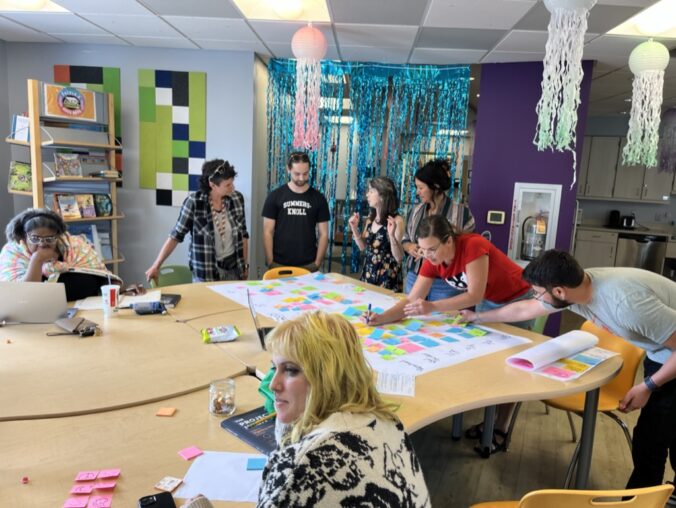
The beginning of a new year. The beginning of a new season. The beginning of a new moon. Life is full of new beginnings. Prior to the first day of school with kids, the Summers-Knoll faculty and staff gather together to mark the beginning of a new school year. Over the course of two weeks, teachers toggle back and forth between designing/setting up their classrooms and engaging in professional learning sessions through which we cultivate a deeper understanding of who we are as individuals, who we are collectively as a learning community, and how we will pursue our shared goals as a project- and place-based school.
As Executive Director of Teaching and Learning at Summers-Knoll, I embrace the beginning of a new school year as an opportunity for each of us to reflect upon who we are and why we are here (our soul’s purpose). By grounding ourselves in (re)connecting with our innermost selves and what drives us in our commitments in the field of education (and at SK in particular), we can then think about what we want to teach and how we want to go about the complex work of teaching in the new school year. As such, our starting point as educators is our own and each other’s humanity.
While the beginning of a new school year serves as a touchstone for conscious reflection and intention setting, the work of nurturing and caring for teachers is constant and must be continuous throughout the school year. When teachers are nurtured and cared for, they can transfer that nurturance and care to their students. (For more on the importance of cultivating a culture of well-being in schools, check out this podcast on Adult Well-Being and Creating a Culture of Care on WestEd’s Leading Voices.) Like other practice-based, care-giving professions, teaching requires constant output. Therefore, teachers need to be supported in consistently filling their own inner-wells to ensure they are recharged and resourced for the vital work of teaching.
So when people ask what I do as the Executive Director of Teaching and Learning, I say that I support teachers in the work of teaching and learning. Yet I recognize that “support” is a vague word, and for those who are not teachers, the complexity of “teaching” and “learning” may not be evident. Supporting teachers encompasses a wide range of responsibilities, including (but not limited to) previewing and selecting curricular resources and materials across subject areas; working alongside teachers to figure out how to optimize the use of new curricular materials; co-constructing curriculum; collaborating with homeroom teachers and specialists to vertically align coursework between grade levels and document this alignment; coordinating as well as facilitating ongoing professional development for the faculty as a whole; and working with each teacher individually to determine their particular needs (e.g., being a thought partner for instructional planning; providing observation and feedback on a particular instructional practice; incorporating content standards into project planning; analyzing assessment data and designing instruction based on that analysis; brainstorming ideas for how to identify and address individual student needs).
Each teacher’s needs vary from day to day, week to week, quarter to quarter, and my goal is to be there for them through it all. This dynamic relationship – with each teacher and with the faculty as a whole – is grounded in the care and nurturance I described at the beginning of this post. Without a foundation and constant commitment to genuine care for teachers as people first, none of this other “support” can be leveraged or sustained for further growth. Therefore, my work as Executive Director of Teaching and Learning begins, and constantly returns to, nurturing teachers’ hearts and souls and advocating for their well-being and self-care (e.g., work-life harmony, good sleep, hydration, movement, time outdoors, social connection, solitude, reflection).
On the horizon of a new school year, we come together to remember who we are and why we are here. By returning again and again to the “who” that inhabits the identity of “teacher” or “student,” we give ourselves a chance to begin again and remember: we are all beautifully and imperfectly human. From this place of humility and connection, growth is always possible.