At the beginning of the school year, alongside establishing rituals and routines, teachers lay the foundations for their classroom communities. To learn and work together, students must get to know one another – and respect and trust one another – as people and as learners. Therefore, “getting the room right” (as one of my dear colleagues, Sri Gyan, at Mount Madonna School used to say) at the beginning of the year is critically important because it sets the tone for everything else that follows.
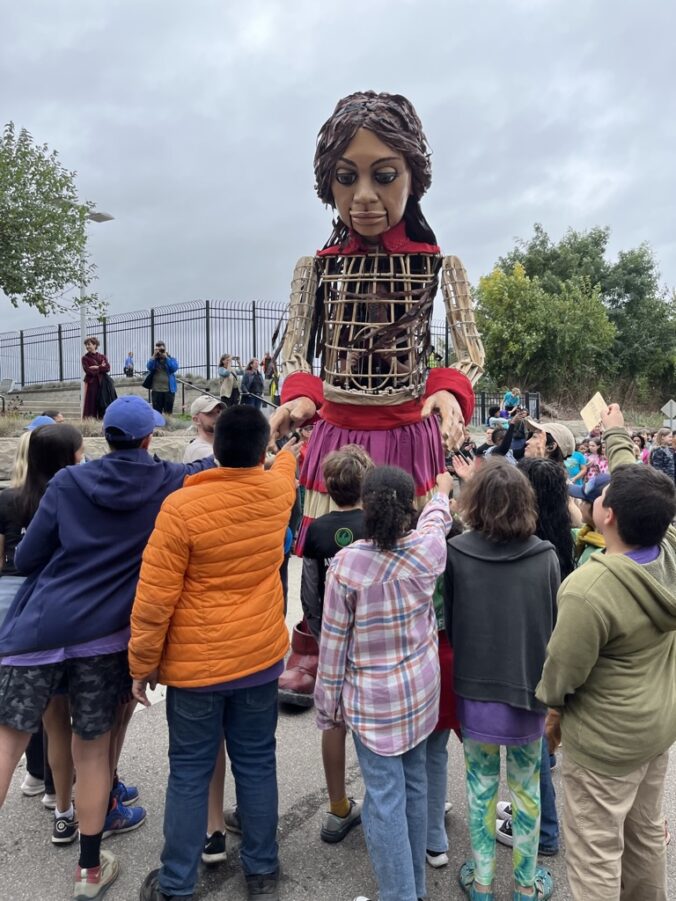
While community building often involves learning about themselves and their classmates, at Summers-Knoll School, students have been thinking beyond just themselves. In the spring of 2023, SK’s 3rd – 8th graders were invited to partner with Mosaic Youth Theatre of Detroit on an event of international scope: Walk with Little Amal. Walk with Little Amal is an arts-based, social justice project designed to raise awareness of refugees worldwide. Little Amal is a 12-foot puppet operated by three human puppeteers who make her come to life. She represents a 10 year old Syrian girl who is a refugee traveling around the world in search of a place to call home. Her journey began in 2021 in Gaziantep, a town close to the border of Turkey and Syria. Since then, she’s traveled across Europe, to 15 different countries, and she just recently landed in the U.S. via the Boston Harbor.
I first learned about the Little Amal project before she even began her journey, when I was working at Michigan State University as a teacher educator and community-engaged scholar. At that time, I was partnering with a local, grassroots, nonprofit organization, the Refugee Development Center, on designing and facilitating literacy and language educational programming for refugee-background youth and young adults, and producing a documentary short, The Stories Project, based upon this collaboration. Given my scholarship and background in theatre, the Little Amal project aligned with how I, too, was looking to the arts as a form of what Sarah Lewis refers to as “aesthetic force,” to raise people’s awareness about (im)migration and refugees; to highlight the importance of fostering an appreciation of people’s differences; to cultivate cultures of belonging in our communities, schools, and classrooms. So, as you can imagine, when SK was invited by Mosaic to join the welcoming committee for Little Amal in Detroit and I proposed the invitation to Eddie (Upper School teacher), Erika (3rd/4th grade teacher), Colin (the music teacher), ArtMary (the art teacher) and Shelby (communications), we replied with a whole-hearted YES!
The timing of Little Amal’s visit to Detroit (September 26, 2023) provided an opportunity for SK’s 3rd – 8th graders to thematically connect their own classroom community building processes with building knowledge about Little Amal, her story, and the plight of over 110 million forcibly displaced people worldwide. In the 3rd and 4th grades and the Upper School, students have been reading, writing, discussing and reflecting upon themes that are central to the meaning of the word community: identity, home, belonging, and welcoming. To deepen their personal investigations and broaden their perspectives, as well as to prepare for their Walk with Little Amal, they have been learning about what these themes mean to people outside of their own community, people in other parts of the world. particularly people who have been forcibly displaced from their homes.
Author and SEMIs coalition partner, Amy Clarice, visited the Upper School and read aloud a picture book story she wrote and published, Lost and Found Cat, about how a human rights volunteer who worked at a refugee camp in Lesbos, Greece (Amy herself) helped reunite a cat with his family after the family was forced to flee from Iraq. The Upper School students then shared some of their own writing on the theme of “home” and read Lost and Found Cat aloud to their 3rd and 4th grade peers. In the 3rd and 4th grade, students have been exploring their family histories, which has helped them see that their ancestors come from many different places from around the world – migration is our shared human story.
In the 1st and 2nd grade, students have been investigating the relationships among sound, color, and emotion to better understand themselves and their emotions. In Kindergarten and Young 5s, students have launched their first project on identity, and in preschool, each student has created a tracing of their body with various body parts labeled to illustrate what they think about (their brains), what they love (their hearts), their favorite foods (their stomachs) and what they like to do (their hands).
Reflecting upon who we are and learning about our classmates reminds us that we are all human. As individual human beings, we are each beautifully unique. When individuals come together to form a community, our differences enable greater creativity, smarter problem solving, deeper relationship building, and a broadening of our individual and collective knowledge. As we learned in our experience with Little Amal, when someone new joins our community, we can welcome them with a smile and perhaps even walk – or dance – beside them for a while.
For more on the significance of diversity – in all of its forms – check out this episode of the Hidden Brain podcast, The Edge Effect, in which Shankar Vedantam and his guests discuss the unique creative force made possible in colloborations where individuals possess different types of knowledge and backgrounds, come from different cultures and countries of origin, and speak different languages. Relatedly, another Hidden Brain podcast that just aired, The Secret of Great Teams, reiterates these points.