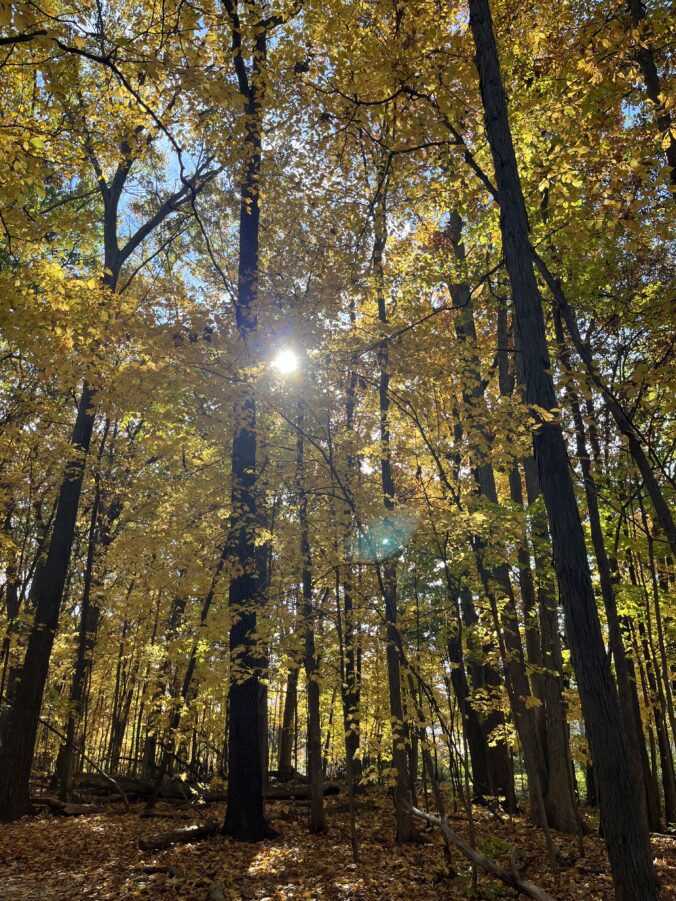
On Sunday, November 3rd, our clocks “fell back” – we were given an additional hour in the day. More time to enjoy the changing color of the leaves. More time to savor the warmth that lingers in the air. More time to appreciate the brilliance of the blue sky, a backdrop to black branches and golden leaves that wave in the breeze like the tips of flames.
More time to hold a door open for someone behind you, offer a hug to a loved one, smile at a stranger, or say “thank you” to the person behind the counter at the grocery store. More time to recognize how much these seemingly small acts of kindness really do matter. Not only do they matter – they are even a source of awe. And through experiencing awe, we are reminded that to be alive in this moment – our life – is fleeting and precious.
In his book, Awe: The New Science of Everyday Wonder and How it Can Transform Your Life (2021), Dacher Keltner helps readers understand what awe is and the importance of it in our daily lives. Keltner and colleagues’ research led to inspiring findings:
“What most commonly led people around the world to feel awe? Nature? Spiritual practice? Listening to music? In fact, it was other people’s courage, kindness, strength, or overcoming” (p. 11).
Teaching and learning require these very things: courage, kindness, strength and overcoming. Bright minds and tender hearts are nurtured through learning communities that intentionally embrace diversity, engage in challenging work, and foster a culture of care and respect. Teachers and students create awe-inspiring places; seemingly small acts of moral beauty take place in multiple moments throughout the school day. Even struggle is necessary and productive. Nature reminds us that some of the most beautiful, awe-inspiring aspects of life are embedded in cycles of transformation.
As Mary Oliver writes in her poem “A Song for Autumn“:
In the deep fall
don’t you imagine the leaves think how
comfortable it will be to touch
the earth instead of the
nothingness of air and the endless
freshets of wind? And don’t you think
the trees themselves, especially those with mossy,
warm caves, begin to think
of the birds that will come – six, a dozen – to sleep
inside their bodies? And don’t you hear
the goldenrod whispering goodbye,
the everlasting being crowned with the first
tuffets of snow? The pond
vanishes, and the white field over which
the fox runs so quickly brings out
its blue shadows. And the wind pumps its
bellows. And at evening especially,
the piled firewood shifts a little,
longing to be on its way.
Through all the changes this fall season inevitably brings, may we continue to make the world an awe-filled place for ourselves and one another.