
When I was a classroom teacher in Denver, CO, I was a “lab classroom” teacher with the Public Education and Business Coalition (PEBC) for five years (2001 – 2006). In this model of professional learning, the lab classroom teacher hosts small groups of local and national colleagues in their classroom throughout the school year to observe their reader’s and writer’s workshops. After the morning’s observations, a PEBC learning coach facilitates a debrief, and everyone eats lunch together. For me, being a lab classroom teacher and being part of the PEBC provided the most impactful professional development I’d ever experienced. Despite the vulnerability I felt, offering my classroom and instruction as “texts” to be analyzed and questioned made me a better teacher; it made me much more critical of the rationale underpinning my instructional decision-making. In addition to hosting visitors, I had numerous opportunities to participate as an observer in other lab teachers’ classrooms. I learned a tremendous amount from watching my colleagues teach. Observing skillful, thoughtful teachers has always been a source of inspiration, affirmation, and reflection.
Fast forward 12 years.
This summer of 2018, in partnership with the Refugee Development Center (RDC) and MSU’s Residential College in the Arts & Humanities (RCAH), and sponsored by Michigan State University’s College of Education: Equity Outreach Initiatives and Residential and Hospitality Services, we launched the first “Summer Reading Lab” project here at MSU. Informed by the PEBC lab model, a group of critical thought partners (K-12 teachers, higher ed colleagues, and doctoral students), youth from the Refugee Development Center’s Summer GLOBE (Gaining Learning Opportunities through Better English) camp, and I engaged in a two-week learning journey. Each day, the observers and I began with a pre-brief of what they would observe that morning. Then, in a “fishbowl” participation structure, I facilitated two 60-minute interactive reading lessons with informational texts. In each class, there were 12 to 16 immigrant-origin students who were in grades 5 through 10 and who spoke multiple languages (e.g., Somali, Swahili, Masalit, Karenni, Kibembe, Arabic, French, English). During the instruction, the adult workshop participants engaged in focused observations of the classroom. After lunch, the youth went on field trips, and the observers and I reconvened for a debrief of the morning’s instruction, which was followed by critical conversations that spurred interrogations of our dispositions and assumptions about immigrant-origin youth and their learning.
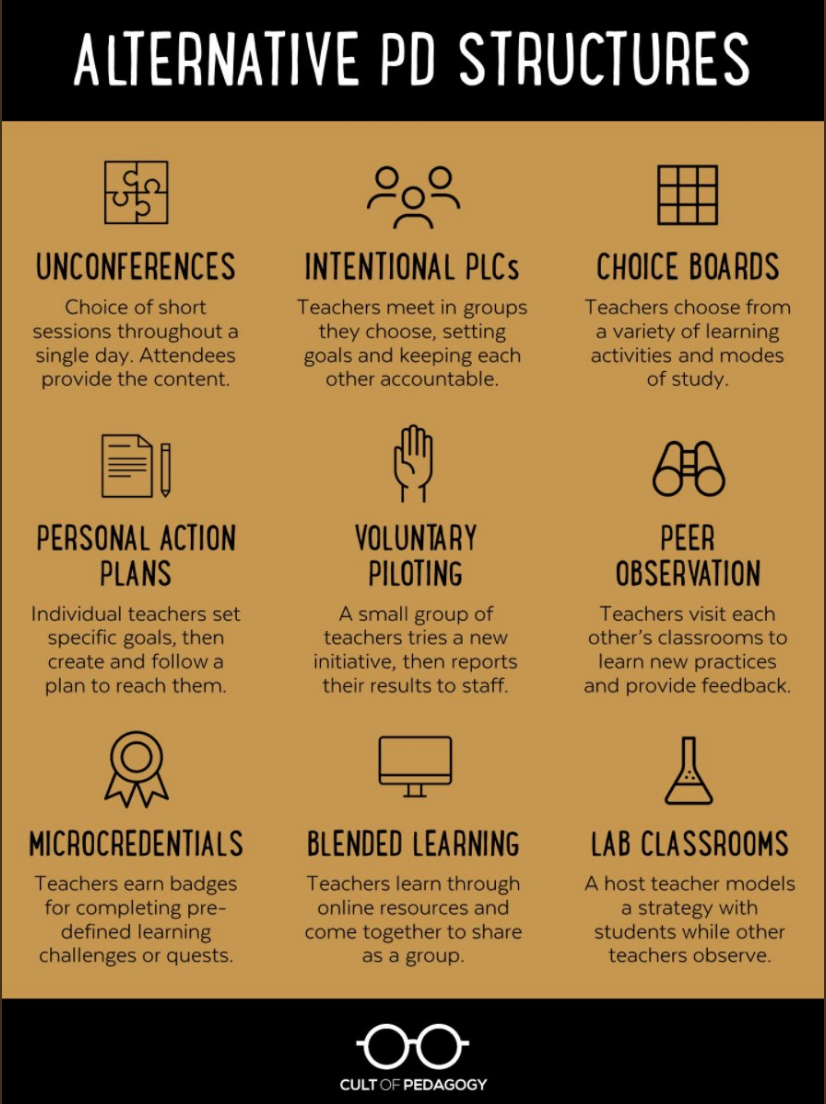
This laboratory classroom model of professional learning has several of the following affordances (ALTERNATIVE PD STRUCTURES image below retrieved from @cultofpedagogy):
By the end of the two weeks, we had become a collaborative group of critical colleagues who had developed a space in which we could ask hard questions of each other and ourselves, challenge our assumptions, engage in role play to experience empathy, write, discuss critical readings, listen to Podcasts, share resources, and eat MSU Dairy Store ice cream (without guilt). This learning space continues on through our conversations with each other, our colleagues, and our teaching.
May our willingness to be vulnerable – as people, learners, and teachers – lead to insights that benefit all sentient beings, especially immigrant-origin youth and their families.