Crafting a concise, clear piece of writing is arguably harder than writing languid prose that read more like a stream of consciousness. Creating a clear, concise piece of writing with a point requires revision. Lots and lots of revision.
Our 3rd – 8th grade students are currently in the midst of writing short stories and many of them will submit their stories to the annual Ann Arbor District Library short story writing contests. Sixth through eighth graders at SK have the opportunity to enter a piece in the It’s All Write contest for Michigan students in grades 6th – 12th. The third through fifth graders have the opportunity to submit to the Write On! kids’ writing contest.
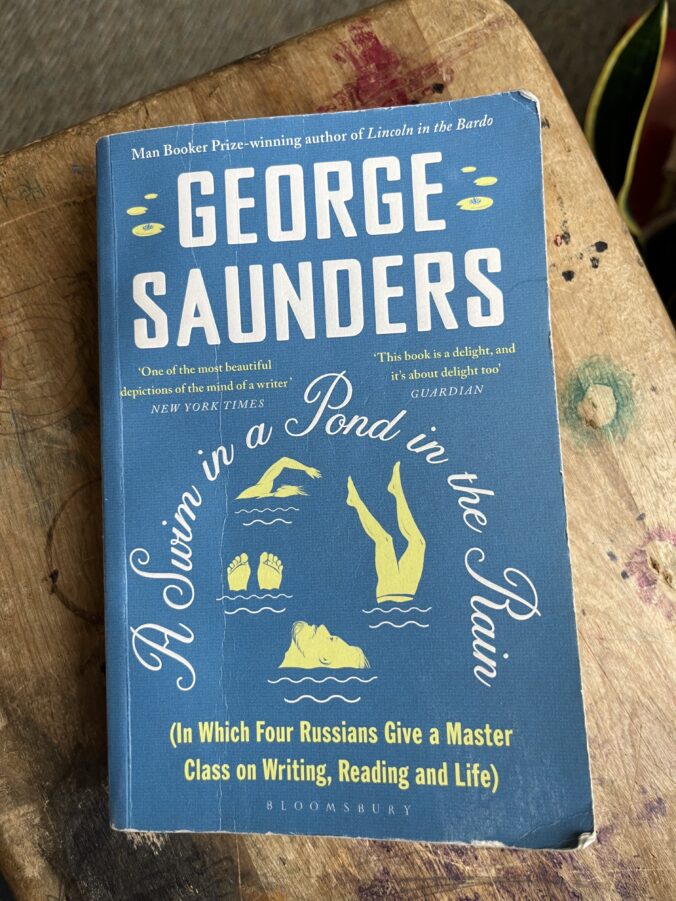
To learn more about the Short Story form, over the winter holiday, I read A Swim in a Pond in the Rain (In Which Four Russians Give a Master Class on Writing, Reading, and Life) by George Saunders (2021). In this brilliant book that illuminates both life and the writer’s craft, Saunders walks the reader through short stories written by four Russian writers: Chekhov, Turgenev, Tolstoy, and Gogol. Each short story is followed by a meticulous, witty analysis in which Saunders helps us, as readers, understand what these authors, as writers, are doing with language to create these heralded short stories.
George Saunders is, himself, an award-winning author who has written collections of short stories, essays, and novels. He is also a professor of creative writing at Syracuse University. So reading A Swim in a Pond in the Rain is like being in class with a humble expert on the subject of writing prose, and short stories in particular. He speaks to the reader as a fellow lover of the written word, a fellow writer, and a student of writing, so his text is at once educative, heart-warming, and enlightening.
Short stories have specific features. As stories, they fall under the category of narrative fiction, although they can certainly be based upon real people and actual events. Short stories are more concise, word count-wise, than a novel. Their existence is compressed. The writer has to do a lot with fewer words, which makes choice a critical aspect of the writing process. What a writer chooses to do – with words and punctuation – matters even more when there are fewer words with which to play.
Over the past few weeks, I’ve been working with Erika (3rd/4th), Eddie and Matt (Upper School) on their teaching of short stories. To share some of the inspiration I gleaned from A Swim in a Pond in the Rain, I provided them with a collection of quotes that I thought might be relevant for a teacher of writing and maybe even – with particular quotes – for a young writer. I’ll share those with you as well below. They provide insight on the craft of writing from a very Saundersian perspective – he invites you, as a reader, to join him as a co-constructor of meaning.
Impact on the Reader
“We might think of a story this way: the reader is sitting in the sidecar of a motorcycle the writer is driving. In a well-told story, reader and writer are so close together that they are one unit. My job as a writer is to keep the distance between motorcycle and sidecar small, so that when I go right, you go right. When I, at the end of the story, take the motorcycle off the cliff, you have no choice but to follow.” (p. 56)
“But the true beauty of a story is not in its apparent conclusion but in the alteration in the mind of the reader that has occurred along the way.” (p. 56)
Relevance – Honor Efficiency
The pace of a story versus the pace of real life: “the story is way faster, compressed, and exaggerated–a place where something new always has to be happening, something relevant to that which has already happened.” (p. 19)
“A story is not like real life; it’s like a table with just a few things on it. The ‘meaning’ of the table is made by the choice of things and their relation to one another.” (p. 46)
“Everything is connected and purposeful. If you give a character a particular trait and show the reader how that character has that trait, but that trait is not used somehow later in the story, then it is slightly wasteful.” (p. 23)
“One of the tacit promises of a short story, because it is so short, is that there’s no waste in it. Everything in it is there for a reason (for the story to make use of).” (p. 25)
“Every structural unit needs to do two things: (1) be entertaining in its own right 2) advance the story in a non-trivial way.” (p. 40)
“That’s really all a story is: a series of things that happen in sequence, in which we can discern a pattern of causality.” (p.224)
Honesty
“A work of art moves us by being honest and that honesty is apparent in its language and its form and in its resistance to concealment.” (p. 34)
“When we ‘find our voice,’ what’s really happening is that we’re choosing a voice from among the many voices we’re able to ‘do,’ and we’re choosing it because we’ve found that, of all the voices we contain, it’s the one, so far, that has proven itself to be the most energetic.” (p.104)
Character Development
Characterization through specification – as the story progresses, the character becomes more specific, more unique, just as human beings are unique. “The story form reminds us that a human being is never static or stable.” (p.38)
“Specificity makes character.” (p. 87)
“We sometimes say that what makes a piece of writing a story is that something happens within it that changes the character forever.” (p. 49)
“Why do we even need descriptions of characters in the first place? For that matter, why do we need characters? […] so that they can fulfill the purpose required of them by the story” (p.94)
Revising – Be Specific
A “good writerly habit” is to be “continually revising toward specificity” so that specificity can appear and then produce plot or meaningful action (p. 140)
“You don’t need an idea to start a story. You just need a sentence. […] We’ll find our voice and ethos and distinguish ourselves from all the other writers in the world without needing to make any big overarching decisions, just by the thousands of small ones we make as we revise.” (p. 112)
Escalation – Always be Escalating
“What transforms an anecdote into a story is escalation. Or, we might say: when escalation is suddenly felt to be occurring, it is a sign that our anecdote is transforming into a story.” (p. 135)
“What is escalation anyway? How does a story produce the illusion of escalation? One answer: refuse to repeat beats. Once a story has moved forward, through some fundamental change in the character’s condition, we don’t get to enact that change again. And we don’t get to stay there elaborating on that state – not, as in this case, for two full pages.” (p. 151)
“The preferred, most efficient, highest-order form of energy transfer is for a beat to cause the next beat” (p.226)
“A story means, at the highest level, not by what it concludes but by how it proceeds.” (p. 334)