In the field of education, and in particular teacher education, there’s a pervasive myth that deserves repeated debunking. Myth: Some people are just born to teach; teaching ability is innate, not something that can be learned or developed. Truth: Through dedication and high quality instruction, people can become highly effective teachers. Like other human-centered professions (e.g., medicine or law), teaching requires a tremendous amount of skill. But what, exactly, distinguishes a teacher from someone who’s very knowledgeable about their line of work (i.e., a content-area expert)?
“The work of teaching is not something that’s very well understood by the public…” Dr. Deborah Loewenberg Ball says in her 2014 presentation to the Legislature’s joint House and Senate Education Committees.
In her presentation to the Committees, Dr. Ball takes 6 minutes to illustrate what distinguishes a teacher from other professionals. She uses an example of a multi-digit multiplication problem that was solved by three different students who arrived at three different (wrong) answers. She invites the committee members to briefly examine the students’ work, and then she asks them to “ascertain what it is that the student did wrong to produce these answers.”
After viewing the students’ work for a few moments, the committee members are silent. Her question seems to have stumped them. She waits a bit longer and then asks:
“Is there any one of you who believes right now that you understand the steps that produced the errors in all three cases?”
No one responds.
“For two of the three?” No one responds.
“For one?”
Dr. Ball then proceeds to use this humbling experience as an opportunity to illustrate what distinguishes an elementary school teacher from people who are well-educated and/or content-area experts, even mathematicians. One of the central distinguishing features of a teacher is their ability to recognize the logic underpinning students’ problem solving processes. Whether it’s an actual problem in math or an interpersonal conflict with a peer or a student’s phonetic spelling, “errors” are windows into students’ thinking.
As a teacher, I have tremendous trust in my students. I trust that, as individuals with unique backgrounds and minds, they each approach learning in highly individualized ways. This is not to say that there aren’t trends and patterns in how we, as humans, operate and learn. Decades of research has helped us see that there are, in fact, fundamental—albeit complex—principles of how people learn.
But a major part of our job as educators is to trust that there is a logic informing every student’s meaning-making—it may not be our logic, but that’s precisely the work of a teacher: to analyze and understand how each of our students makes sense of what they are learning. And there’s a term for this, coined by educational psychologist, Lee Shulman: pedagogical content knowledge.
“Teaching must properly be understood to be more than the enhancement of understanding; but if it is not even that, then questions regarding performance of its other functions remain moot. The next step is to outline the categories of knowledge that underlie the teacher understanding needed to promote comprehension among students” (Shulman, 1987, p. 8):
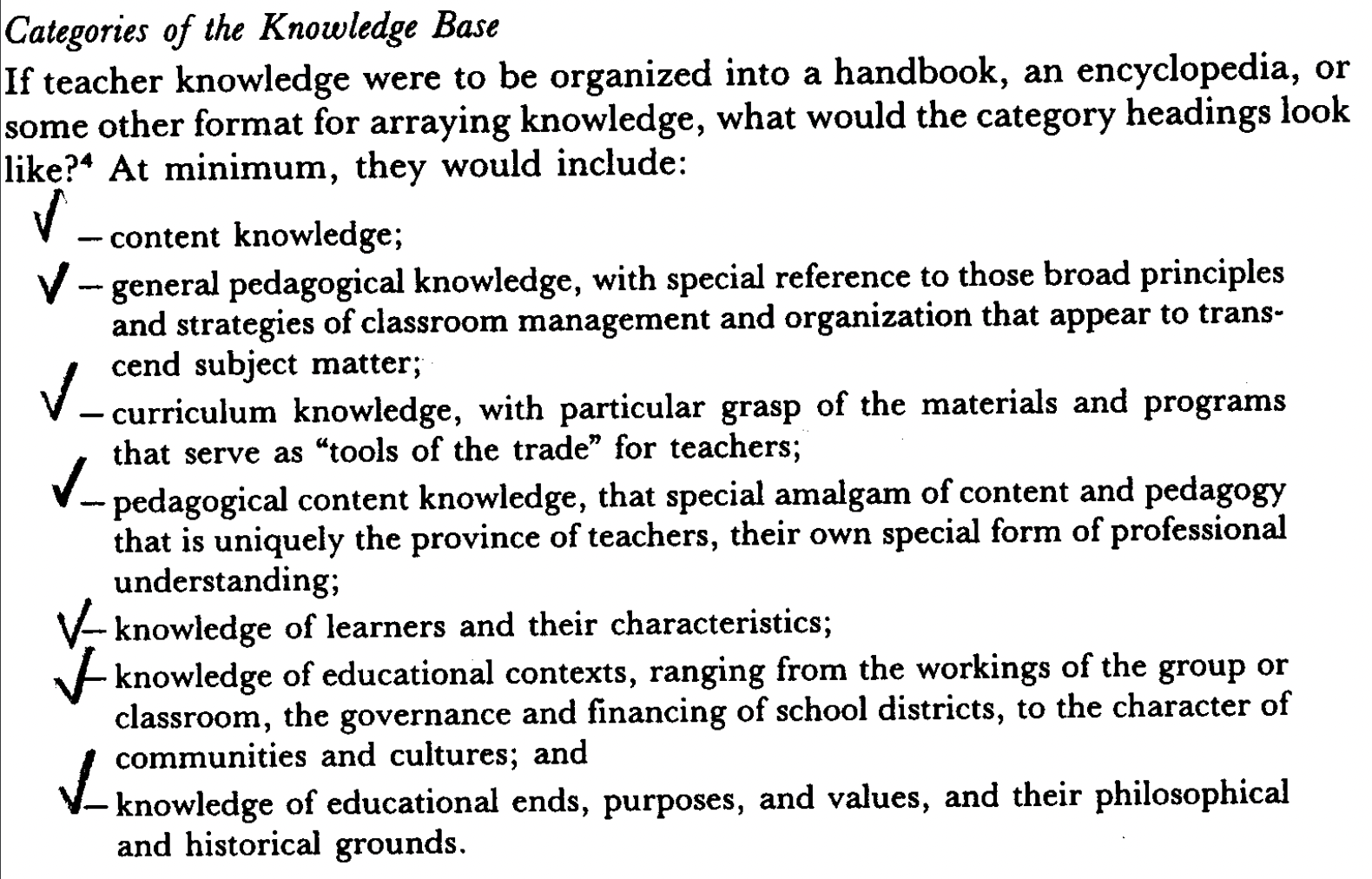
Shulman, L. (1987). Knowledge and teaching: Foundations of the new reform. Harvard educational review, 57(1), 1-23.
Teaching requires not only knowing the content; it requires specialized knowledge that enables someone to teach that content and make that content accessible and engaging for an array of diverse learners. Teaching requires deep knowledge of individual children and children, in general, at various ages, developmental stages, and phases of growth. And it requires creating the conditions in which learners can safely explore, take risks, fail, experiment, succeed, develop, learn, grow, and imagine.
Dr. Deborah Loewenberg Ball was one of my teachers. When I was earning my PhD at the University of Michigan, she was the Dean of the School of Education, and I had the great fortune of taking one of her classes. She made a profound impact on me, not because of what she taught (the content)—although that was important as well—but who she was (and is) as a person and teacher and how she taught. Dr. Ball began her career as a teacher of children, and she became a teacher educator and a teacher of other teacher educators. Throughout, she has remained a lifelong learner who is deeply connected to the work of teaching in the elementary classroom. Through her research and teaching, she continues to impact teachers’ and children’s lives around the world.