
At the American Education Research Association’s (AERA) 2017 Annual Meeting in San Antonio, I met Ester de Jong, president of the TESOL International Association, professor of bilingual/ESOL at the University of Florida, and a leading scholar in the field of language teaching and learning.
I had just made my way to take a seat in the third row of chairs at the Second Language Research SIG business meeting when I saw my colleague and friend, Peter De Costa, talking with Ester, who was the keynote speaker for this event. He introduced us and excused himself.
“So where are you from?” Ester asked.
I’ve learned to think about who I am talking to before answering this question. There are so many possible answers. I can respond simply with, “Michigan State University.” Or I can provide a bit more context so that I give some basis for a response. I chose to provide a more elaborated answer for Ester. I told her that I was from Michigan State University’s Department of Teacher Education. And I quickly followed with where I had been before that for my doctorate: the University of Michigan, working with Annemarie Palincsar and Mary Schleppegrell.
She said, “Oh, so you do SFL?” (SFL is the acronym for Systemic Functional Linguistics, a sociolinguistic theory of language development attributed to Michael Halliday, which is Mary Schleppegrell’s expertise.)
This response from fellow language scholars always makes me tremble a bit. Before pursuing my doctorate, I was an elementary classroom teacher with a passion for literacy. I still very much identify as a teacher with a passion for all things literacy. However, I do not consider myself a linguist. I don’t even speak more than one language…yet.
For most of my life, I have considered myself a monolingual English speaker. I am just now learning Spanish so at this point I identify as an emergent bilingual. My husband is biliterate. Spanish is his first language, and English is his second. He can use either language, in any modality, fluently. I admire him and others who can do so. Although I am working on learning Spanish, I still very much feel like a monolingual and feel limited by my monolingualism. The more Spanish I learn, the more this will change.
People who “do” SFL, in my opinion, are linguists. They have extensive knowledge about language(s) with specific knowledge about systemic functional linguistics and the metalanguage associated with it. The first time I learned of SFL was when I joined the Language and Meaning research team co-directed by Mary Schleppegrell and my advisor, Annemarie Palincsar. Language and Meaning was a three-year, design-based research project. Over the three years, we worked with 29 teachers in grades 2 through 5 and 14 literacy coaches in six schools. The purpose of the project was to design a curriculum informed by systemic functional linguistic theory (i.e., a view of language development as a social process that occurs for communicative purposes). There is a functional metalanguage (e.g., processes, participants, circumstances of time and place, connectors) that accompanies the theory, which provides a way to talk about the features and structures of language in a text. Unlike traditional grammar, an SFL functional grammar focuses on the meanings that are communicated at the level of a clause, sentence, or paragraph. As was learned through our partnership with teachers in the Language and Meaning project, when applied to a language arts curriculum for elementary classroom teachers, an SFL-inspired functional grammar should be used in service of reading comprehension and meeting content area objectives. Otherwise, it can become an isolated exercise of text analysis for text analysis’ sake with no meaning or purpose.
My dissertation grew out of my work with the Language and Meaning project. Since 2011, I have diligently studied theories of language development and how these (particularly SFL) can be applied to teachers’ literacy instruction with and for emergent bilinguals (i.e., students who are learning English as an additional language). Now, as a launch my own research agenda, I recognize SFL as one possible tool teachers can use to support their own understanding of the language demands in the texts they use for instruction which can then translate to providing support for emergent bilinguals’ language development within the context of meaningful, content area learning.
And so I said to Ester, “Well, I definitely see SFL as one possible tool teachers can use to support their own understanding of language which can then translate to providing support for emergent bilinguals’ language development….” Then I paused, considered how honest I wanted to be, and proceeded, “…but I’m not a linguist so I never feel comfortable saying I do SFL.”
With her hands clasped behind her back, Ester looked down at the floor just passed her right shoe, turned her gaze back to mine and said, “And that’s probably how the teachers you work with feel.”
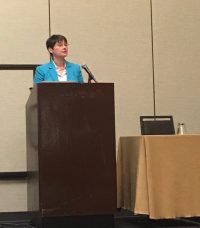
Ester de Jong, AERA SLR SIG Business Meeting, 2017
Every once in a while, someone offers you a piece of wisdom that can slightly but profoundly shift the way you perceive yourself. I took a risk by telling Ester de Jong how I really felt about being a scholar who is familiar with SFL but not an expert in it. And the risk paid off. What I had been perceiving as a weakness was reframed as a strength by someone who knows language and knows learning, and in some way, knew me even though we had just met. This would not have been possible if I hadn’t allowed myself to be honest and vulnerable in that moment. This would not have been possible if she hadn’t taken the time to be present and listen.