Diversity, equity, inclusion, and justice (DEIJ) are not new ideas, but within the past decade – across public and private sectors – organizations, institutions, and companies have increasingly made it an explicit part of their mission and/or vision. Despite the importance of each of these constructs, their meanings are often assumed. Like many acronyms, DEIJ has become ubiquitous, and ubiquity often reinforces assumptions. But for an organization to genuinely embody and reflect these ideals, they need to be kept alive, iteratively interrogated and (re)centered in our conversations about who we are and why we do what we do.
Recently, there has been movement away from the word “inclusion” to “belonging.” Born in Detroit, john a. powell is the Director of The Othering & Belonging Institute at the University of California, Berkeley. He is a renowned social justice activist, educator, and author. As Professor powell helps us understand in his book, Racing Toward Justice, inclusion suggests some sort of gatekeeping – that we somehow need to be given permission (by someone else) to be a part of a community. In contrast, “belonging” reflects the fact that we are all human. By the very nature of our humanity and each person’s inherent dignity, we all belong. Now the question is:
How do we create spaces that reflect this truth?
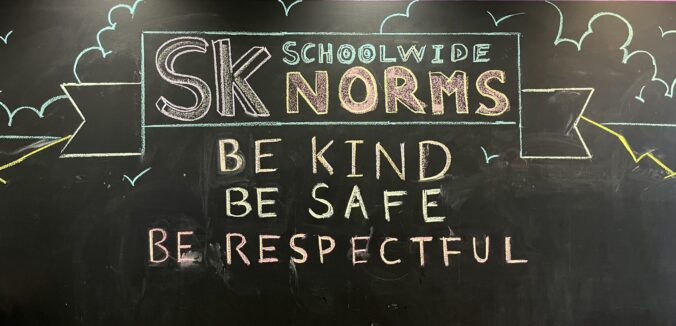
Each school year with each new class of students, teachers and students create classroom agreements. At Summers-Knoll, in 2023-24, those classroom agreements were collected, analyzed and synthesized into three schoolwide norms: Be kind. Be safe. Be respectful. At today’s Dragon Time (our whole school, Friday morning meeting), teachers shared their processes of establishing agreements in their classrooms and students shared examples of how their actions and words reflect our schoolwide norms.
Parents, caregivers and families are a critical part of a school’s culture and they, too, must experience a feeling of belonging.
The fall 2024 issue of the Independent School magazine focused on the vital role of parents, and schools’ relationships with parents, in independent schools. In her article, Debra P. Wilson, the president of the National Association of Independent Schools, wrote:
“Is it objectively harder to parent today than it was in, say, 1981? In a recent Pew Research report, 62% of parents say it is somewhat harder than they thought it would be. Another 26% says it’s a lot harder.
While I should, and do, cut my own parents some slack for some of the more laissez-faire parenting styles of the ’70s and ’80s, I’d say it at least feels harder to be a ‘good parent’ today.
Parenting is no longer just about raising well-fed and well-mannered kids who work hard in school and ultimately find a way to support themselves. The flood of information available to us today means we know all the risks ‘out there’ in the world, including in the virtual world. The world also feels that much more competitive, and we’re more aware of the importance of our children’s inner lives, their emotional and relational well-being. All this good and important information raises the stakes for our parenting choices. The metaphorical bumps and scrapes feel much more consequential.
In this context of increased parental anxiety and societal polarization, independent schools have an important role to play. We can use the uniquely close environments we have built at our schools to better understand parents and partner with them to help our kids through challenging moments. We can build trust with parents so that they better understand the school’s role in looking out for individual students. Ultimately, we can create places of belonging for not just the students in our care but for their parents as well.”
Let’s tell a new story about belonging, one that permeates the walls of the school and reshapes who we are, our communities, and how we help one another remember the importance of honoring each person’s inherent worth and dignity across sectors, spaces, and time.