The work of educational psychologist, Lev Semyonovich Vygotsky (1896 – 1934), has had a significant impact on the field of education and how, in particular, educators conceptualize teaching and learning. One of his central theories – the Zone of Proximal Development (aka ZPD) – helps us understand the importance of accessibility in the learning process.
The Zone of Proximal Development is “the range of abilities an individual can perform with the guidance of an expert, but cannot yet perform on their own” (Cherry, 2023, verywellmind.com). For a learner to develop their knowledge and/or ability in a particular area, they need (what Vygotsky referred to as) a “more knowledgeable other.” To be effective, this “more knowledgeable other” needs to meet the learner in their ZPD. If the “more knowledgeable other” does not meet the learner within their ZPD, the learner will have difficulty developing that knowledge and/or skill.
Educators assess each individual student’s abilities, across a vast array of domains, so that they can do just that: meet students where they are (within their ZPDs) and provide the necessary “scaffolding” for each learner to reach the next level. But sometimes peers are even better at approximating each other’s ZPDs – not because they have read Vygotsky’s work or had formal teacher training but because they are often within (or close to) each other’s ZPDs. When a peer serves as the slightly “more knowledgeable other,” they are more proximate to their peer’s developmental stages. Granted, this is a generalization; even among a group of children who are all the same age, great variability and diversity exists. But generally speaking, children are closer to one another’s ZPDs as compared to an adult’s proximity to a child’s ZPD.
Therefore, when peers have opportunities to work together on a task that requires some kind of learning (e.g., problem solving, physical activity, games, writing, reading), they learn from one another in ways that are different than how they learn from adults.
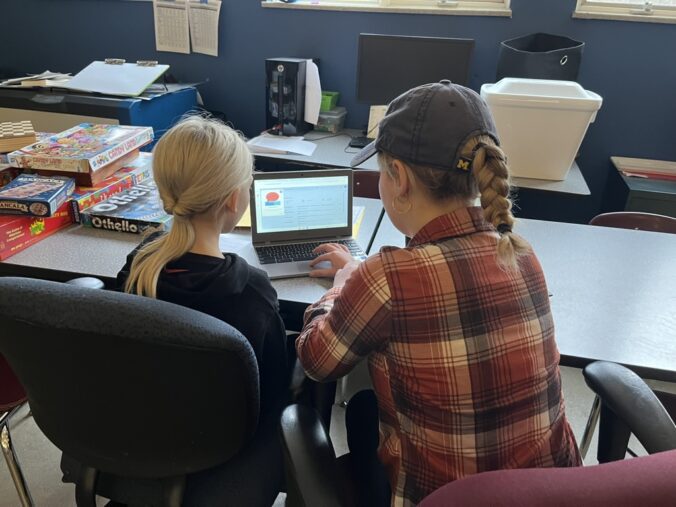
At SK, students have many opportunities to work with peers across grade levels. Each class is paired with another class for buddy time once a week: 7/8s are buddies with the 1/2s, 5/6s are buddies with the Young5/Ks, and 3/4s are buddies with the preschoolers. During buddy time, students engage in a range activities that require learning with, from, and alongside one another.
Teachers also create opportunities for peer mentorship in writing. The 3/4s, 5/6s, and 7/8s all wrote short stories in the month of January, which allowed for writing buddies to provide genre-specific feedback to one another. Although the older students might technically serve as the “more knowledgable other” in this context, it should not be assumed that they are merely “helping” the younger students.
When writers provide feedback to one another on their work, it’s a mutually beneficial experience. Reading someone else’s writing and giving feedback can often lead to a deeper understanding of what I know about writing, which then, in turn, has a positive impact on my own writing.
When structured with intent and opportunities for reflection, both the mentor and the mentee learn and grow from peer-mentorship in ways that are only possible due to being proximate to one another’s ZPDs.