“Had I been given a clear definition of love earlier in my life it would not have taken me so long to become a more loving person.” ~ bell hooks, All About Love, 2000, p. 11
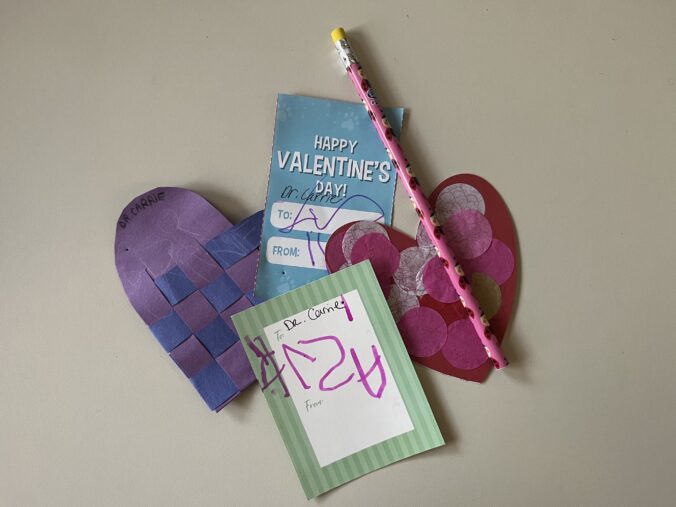
Shoe boxes – decorated with pink and red, paint and tissue paper, and a rectangular hole cut in the top – receptacles for expressions of love from our classmates. Store-bought, classic notecards with the “To:” and “From:” or the homemade, construction paper versions. Heart-shaped lollipops, rock candy, chocolate.
Valentine’s Day at Summers-Knoll looks very much like Valentine’s Day from my childhood school experience in San Antonio, Texas. Some traditions hold strong. Perhaps the main difference for me now, as an adult, is the source of the sweetness. Where once it was candy, now it’s the excitement in children’s eyes as they exchange cards and candy with their peers and teachers.
Some critics of Valentine’s Day say it’s a “Hallmark Holiday,” institutionalized to generate consumerism (Bokat-Lindell, 2020, New York Times). Others point out how it reinforces limiting societal notions of romantic love. These critiques are valid and deserve sensitivity. But when viewed through the lens of a child’s day at school, Valentine’s Day engenders memories of reflecting on my classmates, how to spell their names, and picking out a type of candy I thought they’d like. While I (admittedly) couldn’t wait to receive valentines, there was equal emphasis on giving to other people.
Zooming out to consider the broader opportunity in a day like Valentine’s Day, we can think about the meaning of the word “love.” As Lin-Manuel Miranda said, “Love is love is love is love is love is love.” There are many different kinds of love.
One of the most admired authors, theorists, and educators of our time, bell hooks (1952-2021), also provides a useful contemplation on different kinds of love in her book All About Love (2020). On page 13, hooks writes:
“To begin by always thinking of love as an action rather than a feeling is one way in which anyone using the word in this manner automatically assumes accountability and responsibility. We are often taught we have no control over our ‘feelings.’ Yet most of us accept that we choose our actions, that intention and will inform what we do. We also accept that our actions have consequences. To think of actions as shaping feelings is one way we rid ourselves of conventionally accepted assumptions such as that parents love their children, or that one simply ‘falls’ in love without exercising will or choice, that there are such things as ‘crimes of passion,’ […]. If we were constantly remembering that love is as love does, we would not use the word in a manner that devalues and degrades its meaning. When we are loving we openly and honestly express care, affection, responsibility, respect, commitment, and trust.”
Teaching is one way love is expressed through action. Not just love of children, which is paramount, but love of the potential they hold and the future they will create for themselves as individuals and our society. Love for the planet, for humanity, and for possibilities we have yet to imagine. Love of learning and being a part of other people’s learning journeys. Love of the creative process and creating a learning community in collaboration with other teachers, parents, and children.
One holiday cannot possibly begin to capture all of this love – it’s expressed every day across the school year, in small and big everyday ways, through our words and actions. It’s not glamorous or effusive (except for on Valentine’s Day) – it’s just who we are at our core, our very essence, and that, my friends, is worthy of remembering every day.