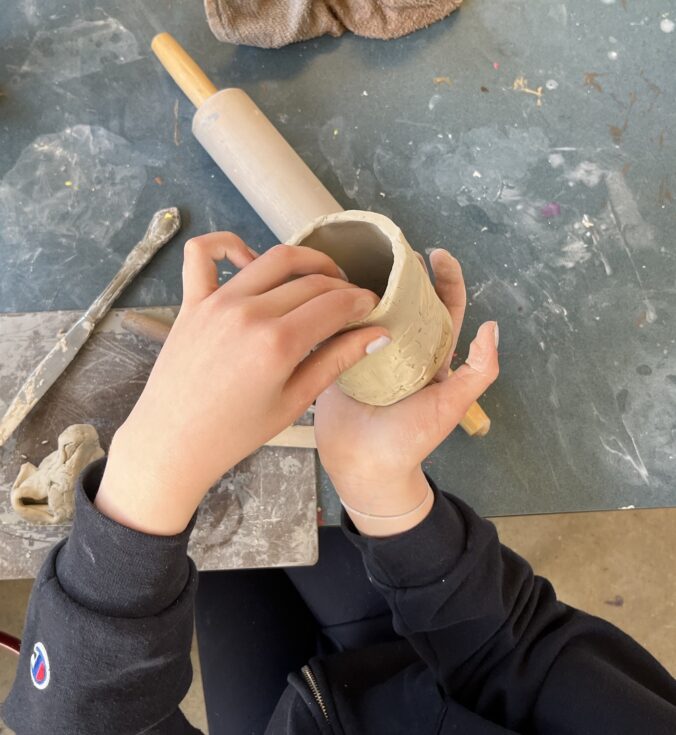
As I scroll through this week’s Summers-Knoll (SK) newsletter, I am struck by a recurrent theme across the images of students learning in classrooms from PreK to 8th grade: learners working with their hands. In a past conversation with ArtMary (SK’s art teacher), they were sharing how they think about the importance of students recognizing how their hands can be used as tools to create. Lately, ArtMary has been thinking about how “hands are your primary way of interacting with reality. They are like antennas or feelers, a sensory organ. So they are not only for manipulating reality, they are also for gathering information and as a result, they give you a more robust experience of reality. Everything you make with your hands educates you further on reality.”
So I decided to step into the art room and ask some 5th and 6th graders for their thoughts on “hands as tools.” And here’s what they had to say:
“It helps you make the design you want to make, and maybe a tool can’t tickle your fancy. So your hands can do whatever you want because you are in command of your hands.” ~ L.L.
“You control your hands. Your hands are what you want to make, not what other people want to make.” ~ N.P.
“You have more control of your hands.You can bend down each individual finger and make them move in different ways, and they can get into places that tools can’t really reach.” ~ H.R.
“Also when you use your hands it looks more natural, more made by you.” ~ M.R.
“Working on other things and making it look like your own instead of something that a machine would make.” ~ N.C.
In contrast to images of classrooms where students are sitting in desks, arranged in rows, facing the “front” of the room where the teacher stands and delivers a lecture (a now outdated design of a learning environment), SK learners are engaged in learning through their bodies, minds, hearts, and hands. Across classrooms and grade levels, these images of engaged learners is so commonplace at SK that it’s easy to take it for granted (just like we may take our hands for granted.)
But this whole body engagement in learning through doing is not commonplace in schools, unfortunately. There are still many classrooms and entire schools where learning is conceptualized as something that happens solely in the mind, despite a robust body of research (including research specifically on project-based learning) that has illuminated how much more deeply we learn when we have meaningful opportunities to socialize, discuss, collaborate, enact, create, build, manipulate, navigate, and transfer ideas from thoughts to words to actions.
From the Singapore Math curriculum, with its emphasis on three modes of representation – concrete, pictorial, abstract – to Project-Based Learning with its emphasis on inquiry and problem-solving, SK students are actively learning through doing. You can see it in their hands.